Case study | SafetyCulture | 7 mins
Agriculture.
From a buried signal - to a working MVP
I uncovered the next industry vertical in our own signup data, designed the evidence to test it, built the prototype, and solved an emerging navigation problem.

Role
Head of Design. Research, UX and UI direction, and the prototype build.
Team
Me - Research, Design, PM
CEO - Consulted, overall decision keeper.
1 x Design System Senior PD
1 x DS ENG
Timeline
4 Weeks
Scope
New nav shipped globally
Vertical decision pending
The situation
A platform strategy that needed its next industry.
Industry verticals are Mitti's big strategic play. They are separately sold modules that tune the platform to an industry. Three were underway. The CEO had an open call out to senior leaders to propose which industry should be next.
The Problem
Agriculture was at the gate but not coming in.
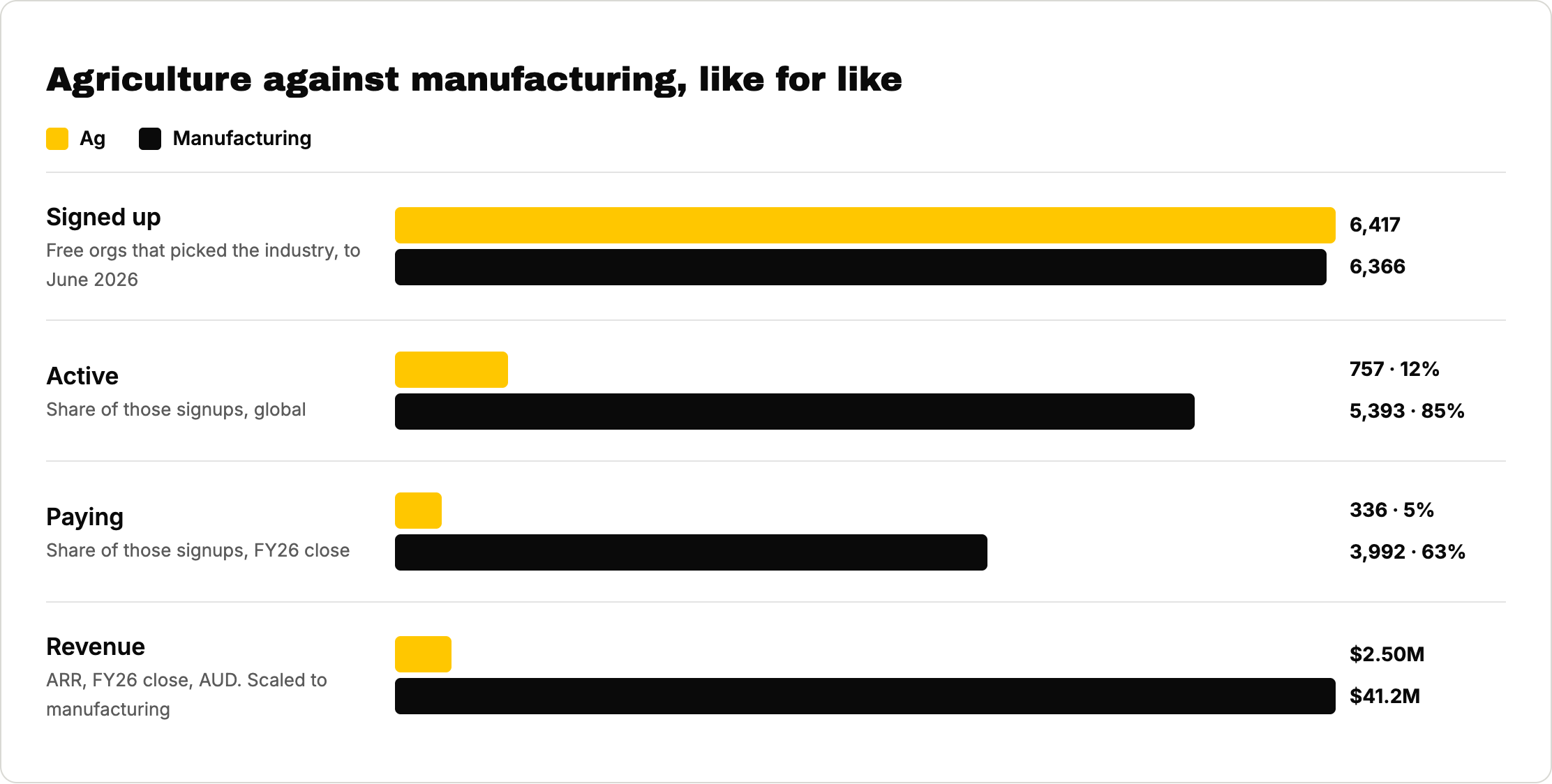
Experimenting with our data through Hex, Glean and Product Board. I discovered Agriculture is the most-picked industry at signup, but almost no paying customers. I read it as a productisation gap.
Ag at a glance
94%
Less revenue than manufacturing. From the same front door. Agriculture ARR $2.50M against manufacturing $41.2M (FY26 close, AUD).
#1
#1 industry people pick at signup. 6,417 free orgs self-identified as agriculture, against 6,366 for manufacturing, to June 2026.
The reframe
Ag isn’t a weak segment.
It's underserved and mis-priced.
“Ag doesn’t pay” was the prevailing assumption I needed to challenge - the data was clear. Ag’s interest in SafetyCulture is high, but we only convert a fraction of it. The problems are product specificity, and how we monetise.
Prioritising for MVP
Landing what to build
Managed agribusinesses already pay $22.5K PA (3 x higher than our ARPA) - so the “Ag doesn’t pay” logic seemed flawed. AI Topic modelling of 757 active agriculture orgs uncovered a long-list of unmet product needs. I ran every feature candidate through three filters.
Filter #1
Underserved Market.
The Ag tech incumbents are machinery and agronomy-led. Features requests that were: weather, yield, inventory, or machinery diagnostic were discounted.
Prioritised features
Filter #2
Built or Building.
Weighting given to features that could be reskinned from existing or in-flight code

#1
A check-in and bio security log, a system of record for people and produce movements.

#3
Freshcare and HARPS audit pack with audit readiness scoring.
Filter #3
Anchored to a standard?
Every vertical needs a regulation or standard underneath it. For agriculture I chose three that underpin commercial viability for farms.
Freshcare
HARPS
LPA Bio Security

#2
An interactive map - recording hazards, chemical usage and movement checkpoints on the farm and homestead.

#4
Chemical registers and seasonal site inductions
Into the build
I worked with AI from the start. Gathered Figma screens from existing projects detailing the functionality I wanted to reskin for Ag, I built a basic ontology as a Figjam flowchart. Pulled Freshcare, HARPS and LPA documentation into the projects context. Then using Claude as a thought-partner to step through the value prop and first-draft flows. I prompted Claude Design to mock up a first draft, constraining output to the rebuilt design system so it would feel real-enough to bounce off customers.
Early results were little more than “pretty gimmicks”. AI over-indexed on digitising granular adherence to the Standards, ignoring the commercial imperative of managing overall site performance. Also it totally looked past SafetyCulture’s earned leverage: the trust we’ve already built with customers to inspect, raise issues and triage serious safety breaches. I prompted my way to something more coherent, and had a testable version in less than a day.
In parallel I interviewed two independent large-scale farms in rural New South Wales. We covered how they manage Freshcare, HARPS and LPA biosecurity today, where the gaps are, what systems they use, and whether what we assumed had value really did. Early signals were strong. I also built and I sparred with an “Ag persona agent” created from 26 prior interviews with Ag customers plus CSM and GTM data. It provides useful challenges about what my core persona would value in the UI/UX.
The prototype attached isn’t finished UI/UX it the sounding board for finding customer traction. I expect to throw 30-50% of it away as we dial in.
Navigation side-quest

Every industry vertical was hitting the same question: where does the secondary navigation live? Construction’s answer, extend the left nav and scroll, wasn’t scaleable. Manufacturing had a double rail that took up too much screen space. Instead I collapsed the expanded-by-default nav the moment you enter a vertical. This gives back screen space and keeps vertical specific features always in reach. As all the verticals select a site first, this solve was reusable for all, agriculture included. Tested, negotiated with each vertical’s stakeholders and adopted into the design system within a week, it is now in production worldwide.
A commercial shift
Seats don’t fit Ag - per-property based pricing is the bet
Per Seat
Capped by headcount
A farm with ten people has a current ceiling value to SafetyCulture of ten seats, but could be producing $13 - 21m in crop value. Crews also triple at harvest and collapse after.
Per Property
Sized by what it protects
Sites, packhouses and depots are the unit of risk and audit. Pricing against protecting the crops route to the big supermarkets unlocks a reframe of the value SafetyCulture provides.
The per-property bet underpins my stop/go hypothesis.
Hypothesis: Managed, multi-site agribusinesses will pay per property for a vertical built mostly from patterns the platform already has.
Per-property pricing
Proceed if: >1 of 4 test accounts accept a per-property pricing
Walk away if: no account will consider non seat based pricing
Demand
Proceed if: >1 of the 4 design-partner candidates commit to the pilot
Walk away if: none commit
Reuse
Proceed if: the MVP is built mostly from existing patterns inside the pod
Walk away if: the map or gate needs more than 50% net-new build
Right customer
Proceed if: managed multi-site agribusinesses give GTM good signal
Learnings
Weak segment? Maybe just mispriced or underserved by product configuration.
Seats model suits our business structure but caps value on a farm. Ten people = ten seats, however much crop is at stake.
Price what you protect. Draw the product line to what the customer values most.
AI is fast at the literal, weak at the commercial. Human judgement had to lead.
Set walk-away tests before the pilot. Knowing when to stop keeps the work honest.
Reuse beats rebuild. Existing patterns underpin the MVP.
Stay open to side-quests 👀